
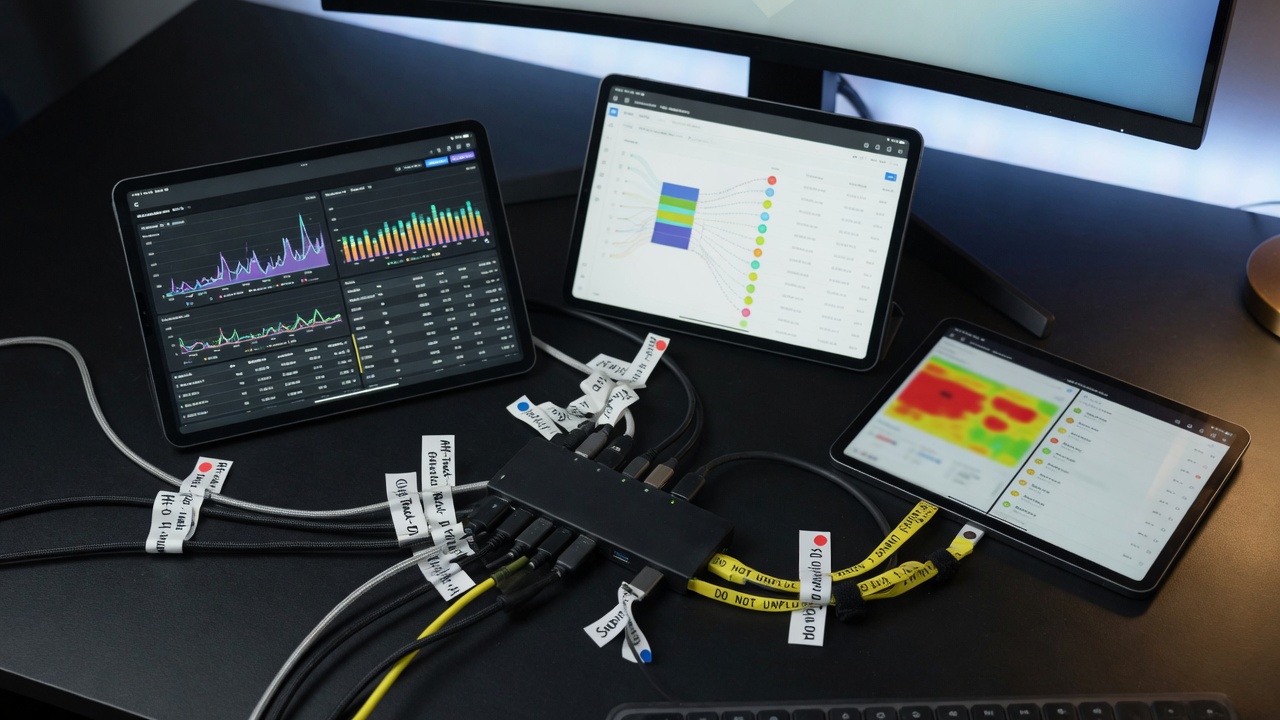
What to Track
Before choosing tools, define what you're tracking. The core questions:
- Which clicks convert? (Per-program conversion attribution)
- Which content converts? (Per-article revenue attribution)
- Which traffic converts? (Per-source conversion attribution)
- What's the EPC? (Earnings per click, per source, per content)
- What's the trend? (Revenue over time, by segment)
The answers drive optimization. Without them, you're flying blind.
Most operators don't track enough. They look at total revenue and traffic, but not the interactions between them. The operators who do track well have a significant advantage.

The Layered Approach
Affiliate tracking has four distinct layers. Each layer addresses different questions.
Layer 1: Network and Program Reporting
What it is: The reporting provided by affiliate networks (CJ, Impact, Awin) and direct programs.
What it tells you: Clicks, conversions, commissions, EPC at the program level.
What it doesn't tell you: Which specific content drove the conversion, which traffic source, which user segment.
The gap: Network reporting aggregates data but doesn't connect it to your content or traffic.
Layer 2: UTM and Link Tracking
What it is: UTM parameters on affiliate links that tag clicks with source, medium, and campaign data.
What it tells you: Which external traffic sources drive clicks and (where networks pass UTM data) conversions.
What it doesn't tell you: Which on-site content drove the click, what users did after clicking.
The implementation: Every affiliate link gets UTMs. Either manually or via a link management tool.
Layer 3: On-Site Analytics
What it is: Google Analytics (or alternative) tracking what happens on your site before the click.
What it tells you: Which pages drive clicks, user behavior before clicking, traffic source breakdown.
What it doesn't tell you: What happens after the click (on the merchant's site).
The implementation: Event tracking on affiliate link clicks, with parameters for article, position, and click context.
Layer 4: Conversion API and Postback
What it is: Server-to-server communication that passes conversion data back to your systems.
What it tells you: Exactly which clicks converted, with full attribution context.
What it doesn't tell you: Cross-device attribution without login-based tracking.
The implementation: Set up conversion APIs with your networks and direct programs. Receive postbacks to your systems.
Most operators stop at Layer 2. Pros go to Layer 4.

The Tools We Use
A practical stack for affiliate tracking:
Google Analytics 4 (GA4)
The baseline for any content site. Free, comprehensive, integrates with most tools.
What we use it for:
- Traffic source attribution
- User behavior analysis
- Affiliate link click events
- Conversion data (where available)
Limitations:
- Cross-device attribution is poor
- Cookie-based tracking is degrading
- Sampling in large datasets
Ahrefs or SEMrush
For SEO-related affiliate tracking:
- Keyword-level revenue attribution (manually correlated)
- Backlink tracking
- SERP feature monitoring
- Competitive analysis
Use the data to identify which content keywords are most monetizable.
Link Management Tools
For managing affiliate links across many articles:
- ThirstyAffiliates (WordPress-specific, not relevant for Nuxt sites)
- PrettyLinks alternative or custom implementation
- Custom solution: Build a
affiliateLinksconfig and resolve at render time
For Nuxt sites, a custom config-based approach works well. Store all affiliate links in a config object, render them at runtime.
Spreadsheet or Database
For manual analysis and reporting:
- Airtable: Flexible, team-friendly, good for non-developers
- Google Sheets: Free, simple, good for solo operators
- Custom database: For large portfolios or complex analysis
We use Airtable for editorial pipeline and spreadsheet for ad-hoc analysis.
Server-Side Tracking
For Layer 4 attribution:
- Google Tag Manager Server-Side: Host your tagging server
- Stape or similar: Managed server-side GTM
- Custom webhook receivers: For direct programs with postback URLs
This is the layer most operators skip. It's also where the biggest attribution improvements come from.
The Implementation
Step 1: Audit Current Tracking
Before changing anything, document what you have:
- Which networks are you on?
- Which direct programs?
- What reporting do they provide?
- What UTMs are you using (if any)?
- What's your current on-site analytics setup?
The audit reveals gaps. Most operators have bigger gaps than they realize.
Step 2: Standardize UTM Conventions
Pick a consistent UTM structure and apply it everywhere:
utm_source: Network or program name (cj, impact, amazon)utm_medium: Always "affiliate"utm_campaign: Site name or content categoryutm_content: Article slug or content identifierutm_term: Click position or specific link identifier
Document the conventions. Train the team. Audit regularly.
Step 3: Implement Click Tracking
Track every affiliate link click as an event:
gtag('event', 'affiliate_click', {
  program: 'amazon',
  article: 'why-niche-markets-win',
  position: 'product-callout-1',
  link_url: '...',
});
The data tells you which articles, which positions, and which programs drive clicks.
Step 4: Connect to Revenue
The hard part: connecting clicks to revenue.
For networks: most pass UTM data through, so revenue can be attributed to specific campaigns.
For direct programs: requires conversion API or postback setup.
For Amazon: requires Amazon's conversion tracking (limited but improving).
The connection between clicks and revenue is where optimization happens. Without it, you're guessing.
Step 5: Build the Reporting
Create dashboards that show:
- Revenue by program, by article, by traffic source
- EPC by program and content category
- Conversion rate by traffic source
- Trends over time
The dashboards should answer your key optimization questions without requiring manual analysis each time.
The Conversion API
The most underutilized tool: conversion APIs.
What They Do
Conversion APIs allow networks and merchants to send conversion data directly to your systems, bypassing the browser-based tracking that's degrading.
The flow:
- User clicks your affiliate link
- User converts on merchant site
- Merchant's system fires postback or sends conversion data
- Your system receives the data with full attribution context
- You have accurate conversion data without depending on cookies
How to Set Up
For major networks:
- CJ: Conversion API available, requires technical setup
- Impact: Conversion API well-documented
- Awin: Conversion API available
- Amazon: Limited but improving
For direct programs:
- Many offer postback URLs
- Some offer full APIs
- Setup varies by program
Set up receivers on your side:
- Webhook endpoint to receive postbacks
- Data warehouse to store conversions
- Reporting layer to analyze
The technical investment is real but the data quality improvement is significant.

The Common Mistakes
Mistake 1: Tracking Everything, Analyzing Nothing
Many operators set up elaborate tracking but never analyze the data. Tracking without analysis is wasted effort.
Start with the questions you want to answer. Build the tracking to answer those questions.
Mistake 2: Trusting Attribution Blindly
No attribution system is 100% accurate. Last-click attribution overcounts the closing touch. First-click undercounts the discovery. Multi-touch is better but more complex.
Use attribution as a guide, not gospel. Combine it with qualitative judgment.
Mistake 3: Optimizing for the Wrong Metric
EPC, conversion rate, RPM, EPC by source — many metrics are useful but they answer different questions.
Pick the metrics that align with your business goals. Don't optimize for metrics that don't.
Mistake 4: Not Validating Tracking
Tracking breaks silently. Programs change their URLs. Networks change their tracking parameters. UTMs get stripped. Conversion APIs go down.
Audit your tracking regularly. Click test links. Verify attribution. Catch issues before they affect decisions.
Mistake 5: Over-Engineering
Some operators build elaborate tracking systems that consume more time than they save. The marginal data isn't worth the engineering investment.
Build the tracking that answers your current questions. Add complexity as questions evolve.
The Privacy-Safe Future
As third-party cookies disappear, attribution degrades. The operators who prepare for this transition win.
The strategy:
- First-party data: Build email lists, user accounts, login experiences
- Server-side tracking: Use conversion APIs to bypass cookies
- Aggregated measurement: Use trend analysis when individual attribution fails
- Direct relationships: Build partnerships where conversion data is shared directly
The future of affiliate tracking is less about clever client-side tracking and more about direct relationships with networks and merchants who share data with partners.
The Bottom Line
Tracking is the foundation of optimization. The operators who track well have a permanent advantage over those who don't.
The investment in building a proper tracking stack pays back through better optimization decisions, better partner relationships, and better business outcomes.
Build it. Maintain it. Use it.
The data is the moat.