

Keyword Research Doesn't Mean What It Used To
Five years ago, keyword research was simple: find words with high volume and low competition, write content targeting them. The tools were straightforward. The strategy was clear.
That world is gone.
Three things changed:
- AI search absorbed huge chunks of high-volume informational queries. When Google's AI Overview answers "what is X" directly, the article targeting that query gets far less traffic.
- Intent got more fragmented. A single keyword now triggers different content types — videos, AI answers, product carousels, forum discussions — depending on who's searching and why.
- SERP features took more real estate. Featured snippets, PAA boxes, image packs, and AI Overviews push organic results further down the page.
The result: traditional keyword research (volume × difficulty = opportunity) undercounts real opportunities and overcounts vanity ones. You need a different framework.

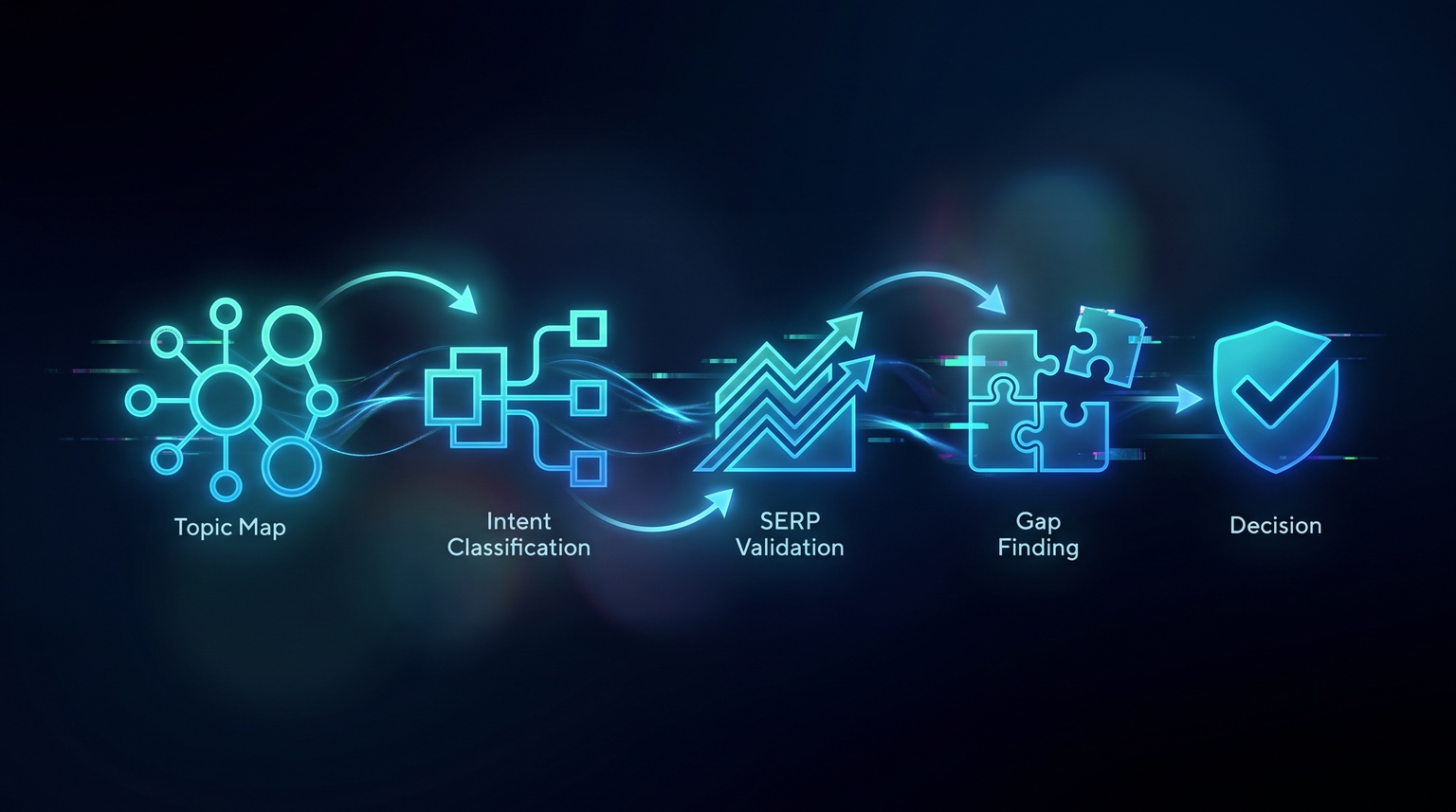
The Process We Actually Use
Step 1: Start With the Topic Map, Not Keywords
Most keyword research starts with a spreadsheet. Ours starts with an outline.
Before looking at search volume, we map the topic: what does a complete resource on this subject look like? What are the obvious questions? What are the less obvious ones? What does the buyer journey look like from "I have a problem" to "I bought a thing"?
This sounds slow. It's actually faster than trawling through 10,000 keywords to find the 200 worth targeting.
The topic map gives us a coverage goal. Then we use keyword tools to fill in the gaps and validate demand.
Step 2: Classify by Intent, Not Just Volume
Every keyword gets an intent label:
- Informational: User wants to learn something
- Commercial investigation: User is comparing options
- Transactional: User is ready to buy
- Navigational: User wants a specific site
The action you take depends on intent, not volume. A high-volume informational query might not be worth targeting if AI Overviews answer it directly. A lower-volume commercial query might be worth a comprehensive guide because the conversion potential is real.
We use a 2x2:
- High intent + manageable competition → Comprehensive pillar content, primary focus
- High intent + high competition → Long-tail variants with specific angles
- Low intent + low competition → Quick-win content for traffic, not conversion
- Low intent + high competition → Skip entirely
Step 3: Validate With Real SERP Analysis
Search volume is a proxy for demand. SERP analysis is reality.
For every keyword we consider, we look at the actual search results:
- What's the dominant content type? If the top 10 results are all forums, maybe the user wants a community answer, not an article.
- Is there an AI Overview? If yes, how much of the query does it answer? Can we add value beyond what AI provides?
- What are the SERP features? PAA boxes tell us related questions. Image packs tell us visual content wins. Video carousels tell us YouTube is part of the competition.
- Who ranks? Big brands, niche sites, forums, retailers? The competition shape tells us what we need to beat.
- What's the freshness signal? News queries need fresh content. Evergreen queries reward depth.
This is the most time-consuming step. We don't skip it. A keyword that looks great on paper but has a SERP dominated by Amazon and YouTube is rarely worth the investment.
Step 4: Find the Gaps the Tools Miss
Keyword tools report what people search. They miss what people should search but don't.
We find gaps by:
- Reading forums and Reddit threads in the niche. What questions keep coming up that don't have good search results?
- Asking customers directly. What did they search before finding us? What almost stopped them from buying?
- Looking at "people also ask" expansion. Google shows 4 PAAs by default; expanding shows dozens. Each is a content opportunity.
- Watching competitors' content updates. When they publish something new, they're chasing a keyword opportunity we might have missed.
- Analyzing search suggestions. Type your seed keyword and look at autocomplete. The suggestions reveal demand the tools haven't indexed.
These gaps often produce the highest-converting content because they answer questions nobody else is answering.
What to Do With High-Volume Informational Queries
These are the queries AI Overviews have absorbed. The traditional advice was "write the best article." That still works for some queries, but for many, the article now competes with a synthesized AI answer.
We approach these by going deeper than AI can:
- Original research and data AI can't synthesize
- Specific, experience-based recommendations rather than general advice
- Visual content (diagrams, comparison tables, photos) that AI text can't replicate
- Interactive tools (calculators, quizzes) that AI can't replace
- Opinionated takes with clear reasoning, not neutral summaries
If we can't go deeper than an AI Overview, we skip the query. The traffic isn't worth the production cost.

Long-Tail Is Still the Best Play
Everyone says "go after long-tail keywords." Most sites don't actually do it.
Long-tail means:
- Specific use cases: "best running shoes for flat feet and knee pain" not "best running shoes"
- Specific demographics: "best CRM for solo consultants under $50/month" not "best CRM"
- Specific comparisons: "Notion vs Obsidian for academic research" not "best note-taking app"
- Specific problems: "how to remove cat urine smell from subfloor" not "how to remove cat urine"
These queries have lower volume individually but:
- Higher conversion rates because intent is specific
- Less competition because tools underreport them
- Easier to rank for because SERPs are weaker
- Better fit for AI search because they often need specific answers
We aim for 60-70% of new content to target long-tail. The head terms get pillar content. The middle is usually a waste.
Tools We Actually Use
A short list, because most teams over-invest in tools:
- Ahrefs or SEMrush for volume, difficulty, and SERP analysis. Either works; pick one.
- Google Search Console for what you already rank for. This is the most underrated tool — your existing impression data reveals opportunities.
- Reddit, niche forums, and Amazon reviews for language your audience actually uses.
- A simple spreadsheet for the topic map and intent classification. Don't let tools dictate structure.
We pay for the first one. Everything else is process and attention.
The 30-Minute Keyword Sprint
When we need to evaluate a new niche quickly, this is the compressed version:
- Brainstorm 20 questions the audience would ask
- Plug them into a keyword tool, expand each to 10-20 variants
- Quick SERP check on the top 10 variants per question
- Flag any with weak SERPs and clear commercial or informational value
- Pick the 10-15 highest-priority keywords for the first content batch
This produces a workable starter map in 30 minutes. The full research happens as the site grows.
The Mindset Shift
The biggest change in keyword research for 2026 isn't technical — it's philosophical.
Stop treating keywords as the unit of work. Treat questions as the unit of work. Each question becomes a piece of content. Each piece of content has a job in your topical map. The keywords are how you measure demand for that job.
Sites built this way compound. Sites built keyword-by-keyword don't.